
The short version: is Polymarket worth using?
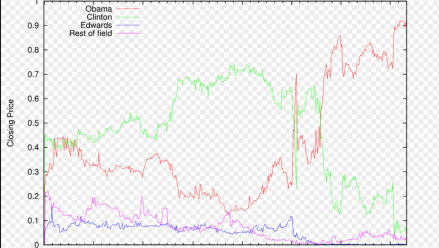
I’ve been monitoring prediction markets for InGame since the 2024 U.S. presidential election race heated up on Polymarket’s international site. When Polymarket’s U.S. beta opened up in late 2025, I signed up within the first week, deposited $40 via debit card on Jan. 9, and have been trading on the platform regularly since.
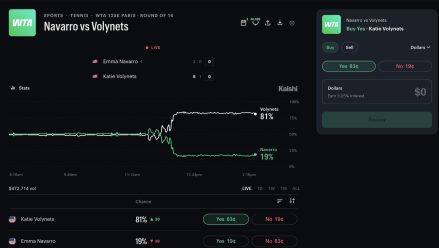
The interface is the fastest I’ve used in this space, and I’ve tested all of the major platforms. The app is clean and intuitive on iOS (the Android experience is not available yet). Behind the scenes, Polymarket has the kind of institutional backing that few competitors can touch: a $2 billion investment from Intercontinental Exchange, the company that owns the New York Stock Exchange, and partnerships with major pro sports leagues MLB, the NHL, UFC, and La Liga.
Fees were once Polymarket’s killer advantage. The platform launched with a tiny flat 0.10% taker fee that made every competitor look expensive. As of April 3, 2026, Polymarket moved to a parabolic fee model with a 5% coefficient, which brings it closer to Kalshi’s 7% coefficient. Still cheaper, but the gap narrowed considerably. Makers now receive rebates rather than just trading free, which is a nice wrinkle.
Market selection in the U.S. is growing but still thinner than what Kalshi offers. And the lack of responsible gambling tools is a real gap — while maybe not top of mind for most users, it is a big area needing improvement.
If you have an iPhone, Polymarket is definitely worth trying. If broader device access is important to you, Kalshi currently has an advantage while Polymarket’s Android app remains unavailable. Of course, having accounts with both (and elsewhere) is key for getting the best price.
Polymarket at a glance
| Platform | Polymarket |
| Founded | 2020 (by Shayne Coplan, New York City) |
| U.S. Status | 49 states (no NV) + DC |
| Regulator (U.S.) | CFTC (Designated Contract Market via QCEX acquisition) |
| U.S. Markets | Sports, economics, elections (as of April 2026) |
| Trading Fees (U.S.) | 5% coefficient taker (max $1.25/100 contracts at $0.50); makers receive 1.25% rebate |
| Deposit Methods (U.S.) | Credit/debit card, bank transfer, or USDC |
| Crypto Wallet Required? | No (U.S. version); Yes (international version) |
| Mobile App | iOS live; Android coming soon |
| Welcome Bonus | Deposit $10 & get a $20 trading bonus (use invite code INGAME) |
| Valuation | $20B+ (backed by Intercontinental Exchange, owner of NYSE) |
| Legal Age | 18+ (19+ or 21+ in some jurisdictions) |
Claim Your $20 Polymarket Trading Bonus with Code INGAME →
18+ Only. Restrictions and eligibility requirements apply. Not available in all jurisdictions. Trading involves high risk and may result in loss of your entire investment. See polymarket.us/tos for more information. The Polymarket US App serves as an independent software provider and affiliate of Polymarket US and Polymarket Clearing, the CFTC-regulated derivatives exchange and clearing organization.
Polymarket U.S. status
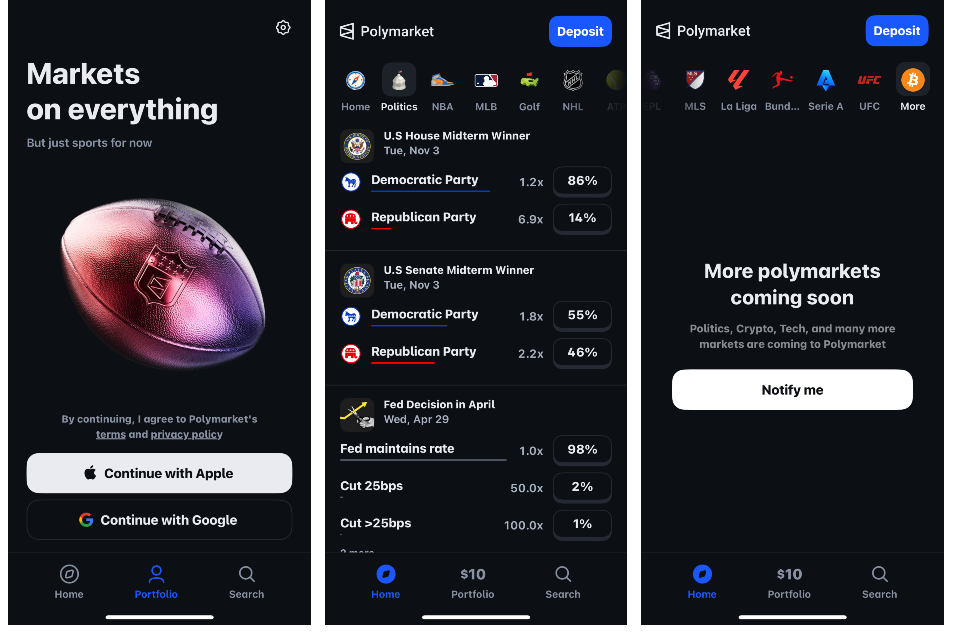
Polymarket’s U.S. platform is live for eligible users through its iOS app. Android is still listed as coming soon. Here’s the condensed timeline of how we got here (for the full history, see our U.S. prediction market timeline):
- 2020: Polymarket launches as a crypto-native prediction market and quickly becomes the world’s largest by volume.
- 2022: Polymarket pays a $1.4 million fine to the CFTC for operating an unregistered platform and shuts off U.S. access. The international platform keeps running.
- July 2025: Polymarket acquires QCEX, a CFTC-regulated exchange and clearinghouse, for $112 million.
- September 2025: The CFTC publishes a no-action letter formally authorizing Polymarket’s U.S. return.
- December 2025: Limited U.S. rollout begins. Invite codes go out to waitlist users on a rolling basis, sports markets only, mobile app only.
- January 2026: Sports trading goes live for beta users.
- April 2026: Economics and elections markets added. Fee structure overhauled from flat 0.10% to parabolic 5% coefficient model.
The current access limitation is device availability rather than a general waitlist. Eligible U.S. users can access the iOS app now, while Android remains coming soon. The company fumbled its initial launch messaging, promising throughout late 2025 that it would be live “soon” while missing the entire NFL regular season. Worth remembering when evaluating any future teasers about timing.
If you’re a U.S. resident, the U.S. version is the only legal way to trade on Polymarket. The international version is viewable in “observer mode,” but trading on it as a U.S. resident would violate Polymarket’s terms of service. (Of course, some users may use a VPN to circumvent this.)
Two platforms, one name: international vs. U.S.
When people talk about “Polymarket,” they’re almost always referring to the international version, the one that went viral during the 2024 election and processes billions in monthly volume. The U.S. version is a separate product with different rules, different infrastructure, and a (much) different regulatory framework.
| Polymarket International | Polymarket U.S. | |
|---|---|---|
| Status | Fully live (180+ countries) | iOS app live for eligible U.S. users; Android coming soon |
| Regulator | Unregulated (decentralized, crypto-native) | CFTC (Designated Contract Market via QCEX) |
| Settlement | UMA Optimistic Oracle (token-weighted voting) | Polymarket Markets Team determines outcomes |
| Markets | Everything (politics, crypto, geopolitics, sports, culture) | Sports, economics, elections (as of April 2026) |
| Fees | Category-based coefficients (~0.75% sports, ~1.80% crypto); geopolitics fee-free | 5% coefficient taker; 1.25% maker rebate |
| Funding | USDC only (crypto wallet required) | Credit/debit card, bank transfer, or crypto |
| KYC Required? | No | Yes (government-issued ID) |
For a deeper look at why this split matters legally, see our analysis of whether the CFTC has any power over Polymarket’s international exchange. The distinction matters for two reasons:
First, because the settlement systems are completely different, and the international platform’s UMA oracle has a documented history of manipulation (more on that in the settlement disputes section).
Second, because the U.S. version doesn’t require a crypto wallet. You can fund your account with a regular debit card (among other ways). That’s a big deal for people who aren’t crypto-savvy or don’t have any crypto holdings.
How Polymarket works
If you’ve used a sportsbook, the basic concept will feel familiar. You’re taking a yes/no position on whether something will or won’t happen. The difference is structural: Instead of betting against the house, you’re trading contracts with other users on an exchange. For a deeper look at the structural differences, see our breakdown of prediction markets vs. sportsbooks.
Every market on Polymarket resolves to either “Yes” or “No.” Contracts trade between $0.01 and $0.99, with the price reflecting the market’s implied probability of the outcome. A contract priced at $0.65 means the market thinks there’s roughly a 65% chance that outcome happens. If you buy “Yes” at $0.65 and the outcome occurs, you collect $1.00 per contract (a $0.35 profit). If it doesn’t, you lose that $0.65.
You can also sell contracts before they resolve. If you bought “Yes” at $0.40 and the price rises to $0.70 based on new information, you can sell for a $0.30 profit without waiting for the outcome. This is where prediction markets diverge from traditional sports betting: You’re not locked into a position (barring the ability to “cash out” at times at different sportsbooks, though usually for far less than true probability of that outcome). The ability to exit, hedge, or double down as conditions change is the core advantage.
Makers, takers, and liquidity
These three concepts drive everything on Polymarket, and understanding them will save you money.
A taker places an order that fills immediately at the current market price. You click “buy,” it executes, you pay a fee. A maker places a limit order at a specific price and waits for someone else to match it. The order sits on the book until it fills, gets canceled, or expires. Makers don’t pay fees on Polymarket. They actually earn a rebate: 1.25% coefficient on the U.S. platform, paid at the point of trade.
The practical difference? If a contract is priced at $0.65 and you buy it instantly as a taker, you pay the taker fee. If instead you place a limit order at $0.64 and wait for someone to sell into you, you pay nothing and receive a small rebate. The tradeoff is time and certainty: Your order might not fill if the price moves away from you.
Liquidity is the depth of the order book, meaning how many contracts are available at prices near the current market. High-liquidity markets (presidential elections, NFL playoff games, federal reserve Fed rate decisions) have tight spreads, meaning the gap between what buyers will pay and sellers will accept is small. You get close to the price you see. Low-liquidity markets have wider spreads and more slippage. A $200 order in a thin market can move the price noticeably. I’ve seen 3-4 cent slippage on smaller markets, which eats into your edge fast.
For most casual traders, the maker/taker distinction won’t make or break you. For anyone trading actively or in volume, learning to use limit orders is the single easiest way to cut your costs. A recent Citizens analyst report found that professional bettors are increasingly moving to prediction markets precisely because they can act as market makers, something traditional sportsbooks don’t allow.
Getting started on Polymarket
The U.S. platform is app-only for trading. The web version puts U.S. users into observer mode where you can browse markets, but can’t execute trades. I tested both the iOS and web experiences and the app restriction was the one thing that caught me off guard.
- Download the Polymarket app from the Apple App Store
- Enter the invite code INGAME when prompted to apply the current Deposit $10 & get a $20 trading bonus offer.
- Create your account with email, Google, orApple login.
- Complete identity verification. Because the U.S. platform is CFTC-regulated, you need a government-issued photo ID. Standard for any regulated financial platform.
- Fund your account. Deposit at least $10 if you want to qualify for the current welcome bonus.. The U.S. version accepts credit/debit cards, bank transfers, and crypto (USDC). No crypto wallet required for card or bank deposits.
- Start trading. Browse available markets, tap into one, review the contract terms, and buy or sell.
Most users report accounts going live within 24-48 hours of completing verification. I was trading within about 18 hours of submitting my ID.
Claim Your $20 Polymarket Trading Bonus with Code INGAME →
Disclaimer: 18+ Only. Restrictions and eligibility requirements apply. Not available in all jurisdictions. Trading involves high risk and may result in loss of your entire investment. See polymarket.us/tos for more information. The Polymarket US App serves as an independent software provider and affiliate of Polymarket US and Polymarket Clearing, the CFTC-regulated derivatives exchange and clearing organization.
Markets and contract types
The international version of Polymarket has the widest selection of prediction markets anywhere. The U.S. version is catching up but is not there yet. Here’s what’s available on each platform, and the types of contracts you can trade.
U.S. platform: sports (live since January 2026)
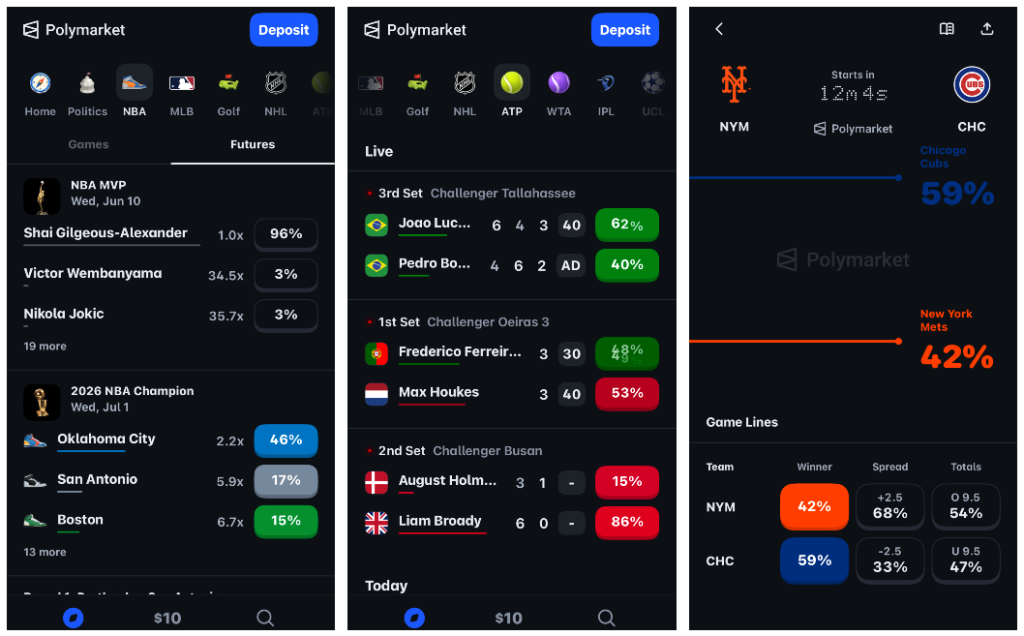
NBA, NFL, MLB, NHL, NCAA basketball, NCAA football, soccer (Premier League, La Liga, MLS), tennis, golf, MMA, boxing, motorsports, esports, cricket, and chess. Hundreds of events are listed daily. The contract types available for sports include:
- Moneylines: Will Team A beat Team B? The simplest contract type. Binary outcome, priced by implied probability.
- Point spreads: Will Team A win by more than X points? Or will B team keep the game within Y points?
- Totals (over/unders): Will the combined score exceed a set number? Available across most major sports.
- Player props: Will a specific player exceed a statistical threshold? Think “Will Jayson Tatum score 30+ points?” Available for major sports but thinner on liquidity than game-level markets.
- Futures: Season-long and tournament-level outcomes. Championship winners, MVP awards, conference titles. These tend to have deeper liquidity because they attract longer-term positions.
U.S. platform: economics and elections (added April 2026)
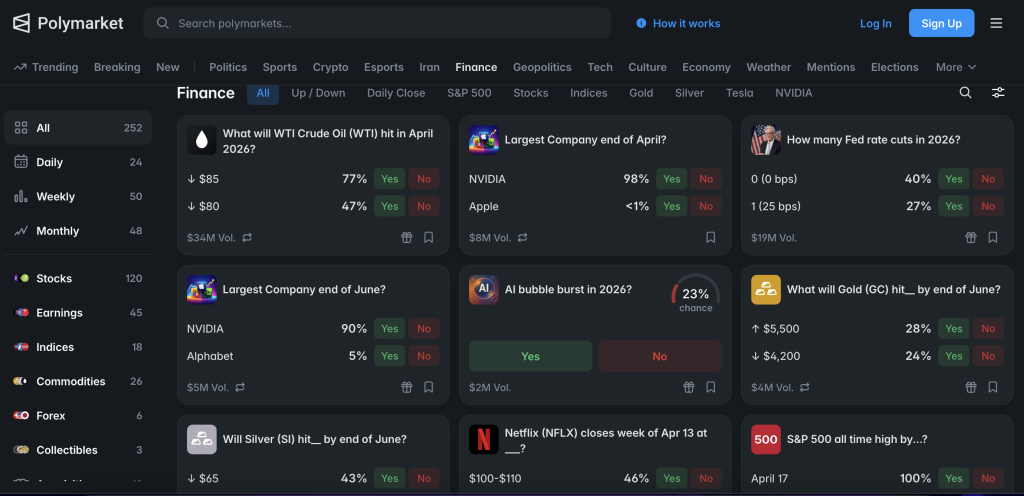
Fed rate decisions, inflation data, employment figures, 2026 midterm primaries, governor races, and Senate races. These are structured as binary contracts: “Will the Fed cut rates at the June meeting?” resolves Yes or No. This category is newer and thinner on liquidity, but it’s expanding. Polymarket’s international platform already demonstrated massive demand for political and economic markets during the 2024 election cycle, so the infrastructure and interest are there. Academic research has shown that prediction market pricing on earnings and macro data can rival or outperform traditional analyst forecasts.
International platform (viewable in observer mode)
The international version covers categories the U.S. platform hasn’t added yet: politics (elections worldwide, government actions, legislation), crypto (Bitcoin and Ethereum price targets, regulatory decisions, protocol events), geopolitics (foreign conflicts, international diplomacy, sanctions), culture (awards shows, box office figures, music), weather, health, and company-specific markets. U.S. users can browse these markets on the web version but cannot trade them legally.
The contract types on the international platform are more varied. Beyond standard binary Yes/No contracts, Polymarket offers multi-outcome markets (e.g., “Which party will win the UK election?” with separate contracts for each party) and ranged markets (e.g., “What will Bitcoin’s price be on December 31?” with contracts for different price brackets). These structures are not yet available on the U.S. platform.
What’s missing from the U.S. version
No crypto markets, culture/entertainment markets, or geopolitical markets for U.S. users yet. No multi-outcome or ranged market structures either. We couldn’t confirm whether or when these categories and contract types will be added.
Polymarket fees
Polymarket’s fee structure changed significantly on April 3, 2026. The old model was a flat 0.10% taker fee, about the simplest and cheapest structure in the industry. The new model uses a parabolic formula that’s closer to how Kalshi charges, though still cheaper at most price points.
U.S. platform fee formula
The current formula is: Fee = 0.05 x Contracts x Price x (1 – Price). The 0.05 is the taker coefficient. Fees are highest on contracts priced near $0.50 (where uncertainty is greatest) and drop toward zero at the extremes. The maximum taker fee is $1.25 per 100 contracts at the $0.50 midpoint.
In practical terms: buy 100 contracts at $0.50 and you pay $1.25 in taker fees. Buy 100 contracts at $0.10 (a longshot) and you pay $0.45. Buy at $0.90 (high likely to occur) and the fee is also $0.45. The symmetry is intentional.
Makers don’t pay fees. They receive a 1.25% coefficient rebate applied at the point of trade. Place a resting limit order for 100 contracts at $0.50, and when it fills you receive $0.31 back. Through April 30, 2026, Polymarket is also running a promotional 50% taker rebate applied weekly, which effectively cuts taker fees in half during the introductory period.
How this compares to Kalshi
Kalshi uses a 7% taker coefficient. Polymarket’s is 5%. On a 100-contract trade at $0.50, Kalshi charges about $1.75 versus Polymarket’s $1.25. That’s roughly 29% cheaper on Polymarket, not the 5-6x gap that existed under the old flat-fee model. The advantage is real but modest, and Kalshi’s maker fees (1.75% coefficient) are higher than Polymarket’s maker rebate, so makers on Polymarket still come out ahead.
The bigger differentiator now may be Kalshi’s 3-4% APY interest on account balances, which Polymarket doesn’t offer. For traders who maintain a significant balance, that interest partially offsets Kalshi’s higher trading fees.
International platform fees
The international version introduced category-based taker fees starting March 30, 2026. The formula is similar (parabolic) but with different coefficients by category: roughly 0.75% peak for sports, 1.00% for finance and politics, up to 1.80% for crypto. Geopolitical and world events markets remain fee-free. Makers earn USDC rebates across all categories through the Liquidity Rewards program.
Fees you should watch for
Polymarket doesn’t charge deposit or withdrawal fees, but your payment processor might. Credit card deposits typically incur a 2-3% processing fee from the card issuer. Bank transfers (ACH) are usually free. If you’re depositing USDC via a crypto wallet, gas fees on Polygon are negligible (usually less than a penny). The fees that will actually hit your wallet come from the crypto exchange where you buy USDC, not from Polymarket itself.
Trading mechanics, pricing, and settlement
Polymarket operates as an order-book exchange. You can place market orders (instant execution at the best available price, taker fee applies) or limit orders (you set the price, it fills when someone matches, no fee plus a rebate). Pricing moves in real time based on supply and demand.
When new information hits, like an injury report or an economic data release, prices can shift fast. This creates both opportunity and risk. If you’re buying into a market right as major news breaks, you may experience slippage, where the price you get differs from the price you saw when you clicked “buy.” Slippage is more common in low-liquidity markets. I’ve seen my order fill 3-4 cents off the displayed price on smaller markets where a $200 position was enough to move things.
When a market resolves, the winning contract pays $1.00 and the losing contract pays $0.00. On the U.S. platform, Polymarket’s internal Markets Team determines outcomes based on pre-specified resolution criteria and data sources listed in each contract’s terms. On the international platform, outcomes are determined by the UMA Optimistic Oracle (a decentralized, token-weighted voting system). The differences between these two settlement systems are significant and worth understanding before you trade. Read on.
Settlement disputes: what can go wrong
Contract settlement is the most important and least discussed part of any prediction market. Polymarket’s two platforms handle it in fundamentally different ways, and both approaches have real problems.
International platform: the UMA oracle
The international version uses UMA’s “Optimistic Oracle,” a decentralized system designed so that no single company decides outcomes. When a market is ready to resolve, a proposer stakes a bond (typically $750 in USDC) and submits an outcome. If nobody challenges the proposal within two hours, it’s finalized. If challenged, the dispute goes to a vote among UMA token holders.
In theory, this is trustless and transparent. In practice, it has been manipulated.
In March 2025, a single UMA token holder used 5 million tokens across three accounts to force a “Yes” resolution on a $7 million market about a Ukraine mineral deal, even though no official agreement existed. Polymarket itself later confirmed the oracle reached the incorrect outcome. In December 2025, a $16 million market on UFO declassification resolved as “Yes” through the oracle despite no public federal notice, with suspicious late-session buying near $0.99. The fundamental vulnerability is that UMA’s token-weighted voting means whoever holds the most tokens gets the most votes. UMA’s circulating market cap sits around $44 million, meaning control of 51% of voting power costs roughly $22 million. That’s a fraction of the capital at risk in Polymarket’s largest markets.
U.S. platform: centralized resolution
The U.S. version takes the opposite approach. Polymarket’s internal Markets Team determines outcomes directly, based on pre-specified resolution criteria and data sources. This is closer to how Kalshi operates.
The upside: faster resolution, no manipulation risk from token whales. The downside: There is no publicly confirmed dispute process on the U.S. platform. If you disagree with how a contract was settled, it’s unclear what recourse exists beyond contacting customer support. For a CFTC-regulated exchange, that lack of transparency around dispute resolution is a notable gap.
The legal landscape around prediction market settlement is evolving fast, with state courts and federal regulators still working out who has authority over what. Before trading any market on either platform, read the full contract terms. Pay attention to the resolution source, the resolution criteria, and any carveouts or edge cases. I learned this the hard way watching Kalshi’s Iran/Khamenei market blow up over a “death carveout” that traders missed in the fine print. The same kind of thing can happen here.
Deposits, withdrawals, and banking
This is where the two versions of Polymarket diverge most sharply, and where a lot of outdated information circulates.
U.S. platform
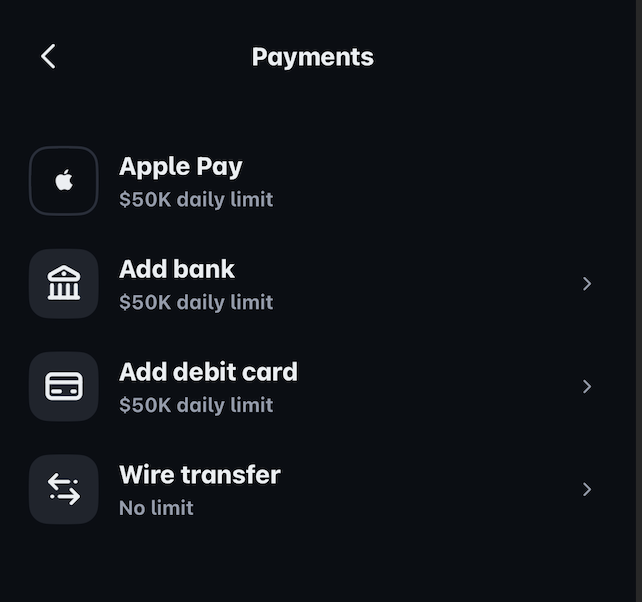
The U.S. version supports conventional payment methods. You can deposit with a credit card, debit card, bank transfer (ACH), or USDC. No crypto wallet required. The platform handles any fiat-to-USDC conversion behind the scenes. Withdrawals go back to the payment method you used to deposit.
There are no deposit minimums beyond the $20 required for the welcome bonus. Deposits typically process within minutes. Withdrawals are usually completed within a few hours, though I’ve had one take about 18 hours during what appeared to be a high-traffic period.
International platform
The international version is crypto-only. You need a wallet (MetaMask, Coinbase Wallet, WalletConnect, and others that support Polygon and Ethereum), funded with USDC. Polymarket recently announced a major infrastructure overhaul including a new collateral token called Polymarket USD, which will replace the bridged USDC.e currently used on the platform. For most users the transition will be handled automatically, though API traders and bot operators will need to update their SDKs.
If you’re unfamiliar with cryptocurrency wallets and don’t want to learn, the U.S. version removes that barrier entirely. If you already live in the crypto ecosystem, the international platform (for non-U.S. users) is a natural fit.
Polymarket app review
| Apple App Store Rating | 4.8/5 (29K+ reviews) |
| Google Play Store Rating | N/A |
| U.S. Trading Access | App only (web version is observer mode for U.S. users) |
The iOS app is excellent. It is genuinely the fastest prediction market interface I’ve used. Browsing markets, checking prices, executing trades — everything loads almost instantly. The UI is clean without being stripped down, and it displays contract prices in American odds format by default (with options to switch to percentage or price views).
The web version is frustrating for U.S. users specifically because you can see everything but can’t do anything. You can browse markets, check prices, read contract terms, and follow volume, but you cannot trade. It’s observer mode only. All trading in the U.S. goes through the app.
Safety, security, and trust
Polymarket’s credibility case is strong on paper. The U.S. platform is CFTC-regulated through its acquisition of QCEX. It has a $2 billion backing from Intercontinental Exchange (the company that owns the NYSE). It has partnerships with MLB, the NHL, UFC, and La Liga. Former CFTC chair J. Christopher Giancarlo leads its advisory board. That’s a lot of institutional validation for a company that was paying a CFTC fine less than four years ago.
On the international side, the trust picture is more complicated. Polymarket’s blockchain-native architecture means every trade is recorded on-chain, providing a level of auditability that centralized platforms don’t match. But the UMA oracle’s manipulation incidents raise legitimate questions about the reliability of the settlement system. The platform removed a controversial market related to nuclear attacks on Iran in March 2026 after public backlash, and it rolled out new insider trading policies around the same time. The broader prediction market industry has struggled to coordinate on integrity standards. These are steps in the right direction, but they also highlight that the platform is still working through growing pains.
For U.S. users specifically, the CFTC regulation, KYC identity verification, and fiat payment integration mean your funds are handled through regulated financial rails. The CFTC is also actively reviewing how direct-clearing exchanges like Polymarket should handle retail customer protections, which could reshape the regulatory framework. This is a fundamentally different risk profile from the international version, where you’re self-custodying crypto in a personal wallet.
Customer support
| [email protected] | |
| Discord | discord.gg/Polymarket (fastest response, open a ticket) |
| Live Chat | Available on the platform |
| Social Media | @Polymarket on X, Instagram, TikTok |
Discord is the move for support. Open a ticket there, and you’ll generally get a faster response than email or live chat. The Discord server also has active community channels where traders discuss markets and report bugs, which is useful for staying current on known issues during the beta period.
Responsible gambling on Polymarket
This is Polymarket’s weakest area right now. The platform does not offer deposit limits. It does not have self-exclusion tools. There are no cooldown periods, no activity alerts, no session time reminders. These are standard features at every regulated sportsbook and online casino in the United States, and Polymarket has none of them.
To be fair, Kalshi and other prediction market platforms have similar gaps. This is an industry-wide issue, not unique to Polymarket. The rise of social media influencers promoting prediction markets to young audiences makes the absence of guardrails even more concerning. But “everyone else is also bad at this” is not a defense. If you’re someone who needs guardrails, prediction markets in their current form don’t provide them, and you should be aware of that going in.
Resources are available through the National Council on Problem Gambling and the 1-800-GAMBLER hotline. Set your own limits before you start trading. Nobody else is going to set them for you.
Polymarket vs. Kalshi
These are the two CFTC-regulated prediction markets that matter in the U.S. right now. They overlap in concept but serve different users in practice. For a side-by-side feature comparison, see our dedicated Kalshi vs. Polymarket page.
Polymarket’s fee advantage used to be dramatic. Under the old flat 0.10% model, it was 5-6x cheaper than Kalshi per trade. The April 2026 switch to a 5% parabolic coefficient narrowed that gap considerably. Polymarket is still cheaper (5% vs. Kalshi’s 7%), but we’re talking about $1.25 vs. $1.75 on a 100-contract trade at 50-cent pricing.
That’s meaningful over hundreds of trades, but it’s no longer a blowout. And Kalshi’s maker rebate structure combined with 3-4% APY interest on balances can offset the fee difference for users who trade patiently and keep money on the platform.
| Polymarket (U.S.) | Kalshi | |
|---|---|---|
| U.S. Accessibility | Open to iPhone users (49 states + DC) | Open to all (49 states + DC) |
| Taker Fee | 5% coefficient (max $1.25/100 contracts at $0.50) | 7% coefficient (max ~$1.75/100 contracts at $0.50) |
| Maker Fee | 1.25% rebate (makers get paid) | 1.75% coefficient (many markets: $0) |
| Interest on Balance | No | ~3-4% APY |
| Live In-Game Trading | Not currently available | Yes |
| U.S. Market Variety | Sports, economics, elections (growing) | Sports, politics, economics, weather, culture, and more |
| Welcome Bonus | Deposit $10 & get a $20 trading bonus | Trade $25 and get up to $500 |
| Parlays / Combos | Not yet | Yes (Combos, launched late 2025) |
| Deposit Methods | Card, bank transfer, USDC | Card, ACH, wire, USDC |
| Brand Partnerships | NHL, UFC, MLB, La Liga, PrizePicks | Robinhood, Coinbase, CNN, CNBC |
| Regulator | CFTC (via QCEX) | CFTC (original DCM license) |
Choose Polymarket if you want lower trading fees (especially as a maker, where you actually get paid), you’re comfortable with a beta product, and you prioritize pre-game sports, elections, or economics trading. The maker rebate model is genuinely attractive for patient traders.
Choose Kalshi if you want broader device access, especially if you use Android, you value live in-game sports trading, you want the deepest market selection in the U.S., or you keep a significant balance and want to earn interest on it.
There’s no reason to choose only one. For a detailed look at Kalshi, see our Kalshi promo code and review page.
What we like and don’t like
👍 What works
- Still the cheapest CFTC-regulated platform for takers. A 5% coefficient versus Kalshi’s 7% means about 29% savings per trade at typical prices. Not the blowout it used to be, but it adds up for active traders.
- Makers get paid, not just zero-fee. The 1.25% rebate coefficient means patient traders using limit orders earn a small return on every filled order. That’s better than Kalshi’s maker structure, where makers still pay fees on many markets.
- The app is fast. Browsing markets, executing trades, checking positions: everything is snappy on iOS. The UI is cleaner than Kalshi’s and noticeably quicker to navigate.
- No crypto wallet required for U.S. users. The single biggest barrier to Polymarket adoption has been the crypto learning curve. The U.S. version eliminates it entirely for card and bank deposits.
👎 What doesn’t
- Fee advantage has narrowed. The move from 0.10% flat to a 5% parabolic coefficient means Polymarket is no longer dramatically cheaper than Kalshi. It’s still cheaper, just not by a factor of 5-6x anymore.
- No interest on deposits. Kalshi pays 3-4% APY. Polymarket pays nothing. Users with large balances are leaving money on the table.
- No responsible gambling tools at all. No deposit limits, no self-exclusion, no session alerts. Industry-wide problem, but still a problem.
Frequently asked questions
Is Polymarket legal in the United States?
Yes. The U.S. version is CFTC-regulated through Polymarket’s acquisition of QCEX, a licensed Designated Contract Market and clearinghouse. It is authorized to operate in all 50 states.
Do I need a crypto wallet to use Polymarket?
Not for the U.S. version. You can deposit with a credit card, debit card, or bank transfer. The platform handles the conversion behind the scenes. The international version does require a crypto wallet and USDC.
How can I access Polymarket in the U.S.?
Eligible U.S. users can access Polymarket through the iOS app. The Android app is still listed as coming soon and is not broadly available yet.
How does Polymarket compare to Kalshi on fees?
As of April 2026, Polymarket uses a 5% taker coefficient versus Kalshi’s 7%, making it about 29% cheaper per trade at typical prices. Polymarket makers receive rebates; Kalshi makers pay reduced fees on most markets. Kalshi pays 3-4% APY interest on balances, which Polymarket does not.
What markets can I trade on Polymarket in the U.S.?
Sports (NFL, NBA, MLB, NHL, NCAA, soccer, tennis, golf, MMA, and more), economics (Fed rate decisions, inflation, employment), and elections (2026 midterms). Contract types include moneylines, spreads, totals, player props, and futures. Crypto, culture, and geopolitical markets are not yet available for U.S. users.
Does Polymarket have responsible gambling features?
No. The platform offers no deposit limits, self-exclusion options, or session time alerts. Resources are available through the National Council on Problem Gambling and 1-800-GAMBLER.
Related InGame coverage
- Polymarket promo code: deposit $10 & get a $20 trading bonus
- Kalshi promo code: everything you need to know
- U.S. prediction markets: a modern timeline
- Prediction market vs. sportsbook: what’s the difference?
- Peer-to-peer sports betting: how does it work?
- States rights vs. federalism: can prediction markets be kept at bay?
- Kalshi vs. Polymarket: which prediction market is better?
- NYSE owner ICE invests $2 billion in Polymarket
- Best prediction market sites for sports betting in 2026
- Polymarket vs. the competition: top alternative prediction markets
- Investment, new players pour into prediction markets
- Two papers show prediction markets are pretty good at what they do
Claim Your $20 Polymarket Trading Bonus with Code INGAME →
18+ Only. Restrictions and eligibility requirements apply. Not available in all jurisdictions. Trading involves high risk and may result in loss of your entire investment. See polymarket.us/tos for more information. The Polymarket US App serves as an independent software provider and affiliate of Polymarket US and Polymarket Clearing, the CFTC-regulated derivatives exchange and clearing organization.